By: Lane Enterprises, LLC
Project Summary
The 2024 CSP & Pipe Arch Project of the Year improved roadway safety while restoring aquatic organism passage along Bigelow Gulch Road near the Spokane River. The project combined custom fabrication, innovative design, and corrugated steel pipe to create a crossing that benefits both motorists and local fish populations.
A Project of the Year with Lasting Environmental Benefits
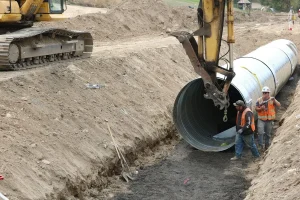
The 2024 NCSPA CSP & Pipe Arch Project of the Year demonstrates how infrastructure improvements can deliver both transportation and environmental benefits.
Submitted by Lane Enterprises, LLC, the Bigelow Gulch Fish Passage project supported a unique crossing designed to restore aquatic organism passage while addressing safety concerns along a challenging roadway corridor. The project also aligned with the goals of the Build America, Buy America (BABA) infrastructure program and required more than 40 tons of galvanized material in a variety of sizes.
Today, the completed crossing helps protect local fish populations while providing a safer and more reliable transportation route.
Solving Safety Challenges Along Bigelow Gulch Road
East Bigelow Gulch Road is a steep, winding two-lane roadway located near the Spokane River.
Winter conditions frequently contributed to traffic accidents and roadway closures. As a result, officials identified an opportunity to improve safety while also addressing environmental concerns associated with a fish-bearing stream crossing.
The final design centered around an aquatic organism passage structure that would allow fish movement through the corridor while supporting the roadway above. The project demonstrates how infrastructure can serve multiple objectives, similar to the Clay County South Dakota Skewed Culvert & Headwall, where site constraints required a customized crossing solution.
Designing a Fish-Friendly Crossing
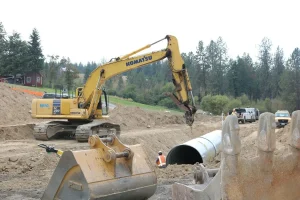
The project required a large crossing structure capable of supporting significant loads while maintaining a natural pathway for aquatic species.
The primary structure consisted of an 84-inch corrugated steel pipe installation extending 623 feet. The final design included more than 40 feet of backfill over the aquatic organism passage structure, creating unique engineering challenges.
Traditional welded baffle approaches raised concerns because of the extreme burial depth. Designers therefore developed a custom solution that would support fish passage requirements while maintaining long-term structural performance.
Similar crossing improvements have been implemented in the Bridge Replacement over Fish Creek, where infrastructure upgrades supported both transportation needs and waterway function.
Custom Fabrication Meets a Unique Challenge
While manufacturing the primary pipe structure was relatively straightforward, the custom fish passage components required extensive fabrication and field preparation.
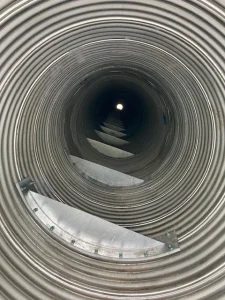
Each baffle required custom cutting to accommodate the corrugation profile and helix angle of the pipe. The baffles were welded to specially fabricated footer plates designed to match the pipe radius.
After fabrication, crews drilled holes into the footer plates to align with the corrugation pattern. Once final placement was determined, an additional 16 holes per baffle were hand drilled into the structure. In total, the installation required more than 1,600 hand-drilled holes to properly secure the baffle system using structural plate hardware.
The project showcases the adaptability of corrugated steel pipe systems and many of the advantages highlighted in NCSPA’s Why Steel, including versatility, durability, and the ability to meet unique project requirements.
Supporting Habitat Restoration and Infrastructure Improvements
The project extended beyond the primary fish passage structure.
Additional drainage improvements required multiple pipe diameters ranging from 12 inches to 36 inches. Some installations required nearly 1,000 feet of pipe, bringing total corrugated metal pipe production for the project to more than 2,400 feet.
These improvements helped create a safer roadway corridor while supporting habitat restoration goals. The project’s environmental focus mirrors the objectives of the Wildlife Crossing Overpass Supports Conservation Goals and the Pipeline Post-Wildfire Flood Mitigation Project, both of which demonstrate how infrastructure investments can protect natural resources while serving community needs.
Building a Better Future for Fish and Motorists
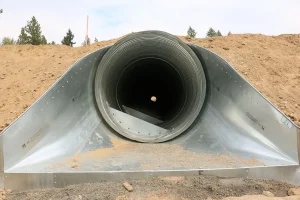
The Bigelow Gulch Fish Passage project demonstrates how modern infrastructure can accomplish more than a single objective.
By improving roadway safety, restoring aquatic organism passage, and protecting local fish populations, the project delivers long-term value for both the surrounding community and the environment.
It is an outstanding example of how corrugated steel pipe can be used in innovative ways to solve complex challenges while creating lasting environmental benefits.