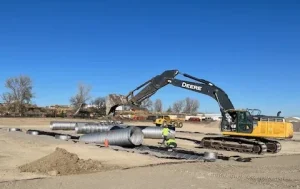
As communities continue to develop, balancing stormwater management requirements with available land has become an increasingly important consideration for engineers and developers. Underground stormwater storage systems offer an effective way to manage runoff while preserving valuable surface space for buildings, parking areas, and other site improvements.For the Slate Storage development in Billings, Montana, corrugated steel pipe (CSP) provided the flexibility and capacity needed to meet stringent municipal stormwater requirements without compromising the property’s development potential.
Submitted by TrueNorth Steel for the NCSPA’s 2026 Project of the Year program, the project demonstrates how early engineering collaboration and thoughtful system design can deliver substantial underground stormwater storage while improving constructibility and long-term performance.
Maximizing Storage Below the Surface
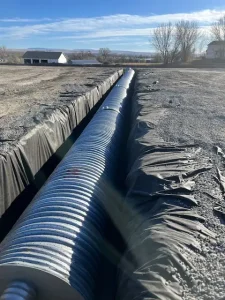
The Slate Storage development required a high-capacity stormwater management solution within a limited site footprint. Rather than dedicating valuable surface area to stormwater storage, the project team developed an underground system that could accommodate the required volume while allowing the property to be fully utilized.
The completed installation consists of 35 individual retention systems and two multi-pipe systems, incorporating 4,661 linear feet of 54-inch-diameter, 16-gauge T2 perforated corrugated steel pipe. Together, these systems provide an impressive 112,188.5 cubic feet of underground stormwater storage capacity, equivalent to approximately 839,000 gallons.
By placing this capacity below ground, the project demonstrates how CSP can help engineers address demanding stormwater management requirements without sacrificing usable land. The pipe’s available configurations and adaptability allowed the design team to develop layouts suited to the site’s spatial constraints while maintaining the required storage capacity.
Engineering Collaboration from the Start
Successful underground stormwater retention design requires more than selecting a pipe diameter and calculating storage volume. Site conditions, available cover, installation requirements, and system configuration must all be considered to develop a solution that performs as intended and can be efficiently constructed.
Recognizing these challenges, TrueNorth Steel worked closely with the project engineer during the early design phase to evaluate feasibility and optimize the proposed systems. Their collaboration focused on optimizing the underground stormwater retention design through efficient pipe sizing, storage capacity calculations, and system layout configurations. By evaluating these factors early, the project team developed a solution that accommodated the required storage volume within the site’s limited footprint.
This proactive approach also allowed the project team to address practical installation considerations before construction began. Cover depths, riser heights, and trim-to-grade details were coordinated during design, helping align engineering requirements with field conditions and reducing the potential for costly adjustments during installation. These considerations reflect the importance of incorporating established CSP installation practices into the design process.
Designing for Constructibility and Long-Term Performance
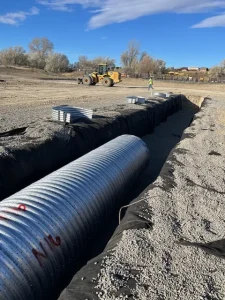
For large underground stormwater installations, constructibility can have a significant impact on project efficiency. Coordinating system details before construction helps contractors anticipate installation requirements, streamline field operations, and minimize the risk of unexpected challenges.
At Slate Storage, TrueNorth Steel’s early involvement helped translate the engineered design into a practical installation plan. Working alongside the project engineer, the team addressed critical details that could otherwise complicate construction, helping contractor K2 Civil execute the underground systems more efficiently.
The use of perforated CSP also provided a durable structural solution for the project’s underground stormwater infrastructure. Combined with careful attention to installation requirements and system configuration, the design was developed to support reliable long-term performance while meeting the project’s stormwater management objectives. Proper material selection and environmental considerations are important factors in determining CSP service life for underground applications.
A Practical Solution for Modern Site Development
The Slate Storage project illustrates the value of integrating stormwater management into the earliest stages of site planning. With more than 112,000 cubic feet of storage distributed across 37 underground systems, the installation provides substantial stormwater management capacity while preserving surface area for the development’s intended use.
Just as importantly, the project highlights the benefits of collaboration between manufacturers, engineers, and contractors. By addressing storage requirements, site constraints, and installation considerations together, the team developed a solution that balanced engineering performance, constructibility, and economic value.
As developers and municipalities continue to seek efficient ways to manage stormwater without limiting land use, projects like Slate Storage demonstrate the versatility of corrugated steel pipe in underground stormwater applications. Through thoughtful design and early coordination, CSP can help turn challenging site constraints into practical, high-capacity infrastructure solutions.