Airport expansions require more than additional gates, larger terminals, and improved passenger facilities. Behind the scenes, engineers must also manage the infrastructure supporting those improvements, including stormwater runoff from expanding paved surfaces. At Hector International Airport in Fargo, North Dakota, a major terminal apron expansion required an underground stormwater detention system capable of meeting demanding site conditions and construction schedules.
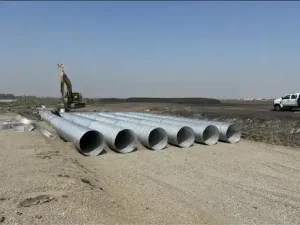
The $155.9 million airport improvement program included a 73,000-square-foot terminal addition with four new boarding gates. Plans also called for renovating 113,000 square feet across five existing gates, expanding aircraft parking areas, and improving passenger access. Additional improvements included a multilevel parking structure, skywalk, and pipeline designed to treat runoff containing aircraft deicing fluids.
However, expanding the airport’s infrastructure created an important challenge beneath the surface. As pavement and buildings replaced available green space, engineers needed an effective approach to managing stormwater runoff. The solution would need to preserve valuable surface area while supporting the airport’s continued operations.
Limited Space Creates a Stormwater Management Challenge
Large commercial developments often face competing demands for available land, particularly when expanding existing facilities. At Hector International Airport, the expanded terminal apron reduced the green space previously available for natural stormwater management. With limited surface area remaining, conventional aboveground detention practices were not practical for the project.
The expansion also needed to satisfy applicable stormwater treatment requirements associated with state and federal funding. These included a state requirement to treat the first 0.5 inches of runoff generated during a rainfall event. Known as first-flush treatment, this approach addresses pollutants carried by the initial runoff from developed surfaces.
Engineers at Mead & Hunt needed a solution that could accommodate both stormwater storage and water quality treatment. Working with Contech Engineered Solutions, the project team evaluated how underground infrastructure could maximize the available development footprint. Contech also provided a land value analysis to support design decisions and improve the efficiency of the expansion area.
The resulting approach incorporated an underground stormwater detention system using corrugated steel pipe. By moving stormwater storage beneath the developed area, the project could accommodate additional airport infrastructure without sacrificing valuable surface space. This approach demonstrates how underground detention can support complex site development where available land is limited.
Corrugated Steel Pipe Provides Strength and Storage Efficiency
Selecting the appropriate underground detention system required careful consideration of site conditions. The proposed installation depth and poor soils presented challenges for alternative storage systems, including plastic chambers. Engineers ultimately selected corrugated steel pipe because its structural strength and round profile suited the project’s requirements.
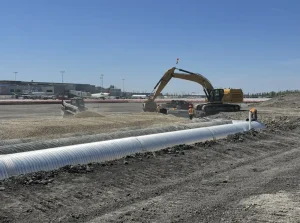
The design incorporated 1,512 linear feet of 66-inch aluminized corrugated steel pipe, arranged in six parallel barrels. Each barrel measured approximately 245 feet long, with a header connecting the barrels at one end and bulkheads closing the opposite ends. Two stubs and three risers completed the underground detention configuration.
Beyond the pipe itself, the design incorporated specialized joints that allowed additional storage within the surrounding rock backfill. This configuration increased the system’s effective storage capacity beyond the volume available inside the pipe barrels alone. Together, the corrugated steel pipe and surrounding stone provided more than 66,000 cubic feet of total stormwater storage.
The project illustrates the versatility of corrugated steel pipe for underground infrastructure applications. Its structural capabilities make it particularly valuable when engineers must balance storage requirements with challenging soil conditions. Additionally, aluminized steel provides a protective coating option for corrugated steel drainage infrastructure.
For engineers evaluating similar applications, the NCSPA’s technical resources provide information supporting corrugated steel pipe design and material selection.
Integrating Stormwater Detention and Water Quality Treatment
Managing runoff volume represented only part of the airport’s stormwater challenge. The project also needed to address water quality requirements associated with the expanded paved surfaces. Consequently, the design combined underground detention storage with a separate stormwater treatment component.
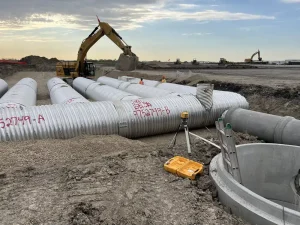
Contech supplied a hydrodynamic separator designed to support the project’s first-flush treatment requirements. The separator complemented the underground detention system, allowing the overall stormwater design to address both runoff storage and treatment. This integrated approach helped the airport satisfy regulatory requirements while working within the available development footprint.
The combination of stormwater detention and pretreatment demonstrates an important consideration for large transportation facilities. Effective stormwater management often requires multiple components working together rather than relying on storage capacity alone. At Hector International Airport, the integrated system addressed the specific runoff management needs created by the terminal apron expansion.
Meeting an Aggressive Airport Construction Schedule
Airport construction presents logistical challenges that extend beyond conventional site development. At Hector International Airport, the expansion required multiple construction phases to avoid interrupting ongoing airport operations. Each phase carried demanding deadlines, leaving little flexibility for delays in underground infrastructure installation.
Park Construction served as the contractor, installing the corrugated steel pipe detention system during summer 2025. Crews used an excavator equipped with straps to handle and position the pipe sections. Excavators, a skid steer, and a dozer supported placement of the surrounding rock backfill.
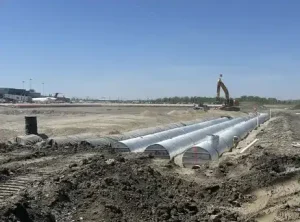
Despite the project’s challenging conditions, crews completed installation of the underground detention system in approximately 1.5 weeks. The work included delivering, positioning, and backfilling the pipe system within the airport’s construction schedule. The straightforward installation process helped maintain progress across the broader phased expansion.
For transportation projects operating under strict construction windows, installation efficiency can be a significant consideration. Corrugated steel pipe systems offer practical advantages through their structural configuration and established installation methods. The Hector International Airport project demonstrates how these characteristics can support demanding construction schedules without compromising stormwater storage requirements.
Supporting Long-Term Airport Infrastructure
With the terminal apron expansion complete, Hector International Airport has an underground stormwater system designed to manage runoff from its expanded facilities. The system provides more than 66,000 cubic feet of storage while supporting applicable water quality treatment requirements. Its underground configuration also preserves valuable surface space for airport operations and future infrastructure needs.
The project highlights the importance of considering stormwater infrastructure early in major transportation developments. By evaluating site constraints, storage efficiency, and construction requirements together, engineers developed a solution suited to the airport’s unique operating environment. The use of aluminized corrugated steel pipe helped address challenging soils while supporting an aggressive installation schedule.
As airports and other transportation facilities continue expanding, effective underground drainage infrastructure remains essential. Projects like Hector International Airport demonstrate how steel drainage systems can help engineers address complex stormwater challenges. In this case, the result was a practical solution that supported both the airport’s expansion and its long-term stormwater management needs.