By: ViaCon
Project Summary
A large underground rainwater retention system in Kaunas, Lithuania, helped manage excessive site runoff while protecting the site from flooding. The project demonstrates how corrugated steel retention systems can provide reliable stormwater management while supporting long-term sustainability goals.
Managing Excess Rainfall in Kaunas
As development increases impervious surfaces and runoff volumes, communities continue searching for effective ways to manage stormwater. In Kaunas, Lithuania, one project site generated significantly more rainwater than the existing infrastructure could safely accommodate.
Without additional storage capacity, excess runoff created the potential for flooding and operational challenges. Effective rainwater retention became essential to protecting the site while controlling discharge into the municipal stormwater system.
Engineers evaluating similar projects often use NCSPA’s Pipe Storage Capacity Calculator to estimate available storage volume and optimize underground stormwater infrastructure designs.
A Large-Scale Rainwater Retention Solution
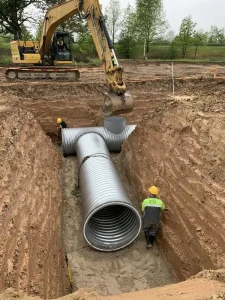
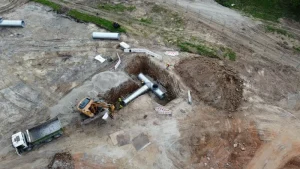
Submitted by ViaCon, the project team developed a large underground rainwater retention system using spirally corrugated steel pipe.
The system was designed to collect runoff from paved areas, green spaces, and building roofs throughout the site. Water is temporarily stored before being released through a flow regulator that limits discharge rates to municipal requirements.
This approach provided the storage capacity needed to manage excess rainfall while reducing peak flows entering the local stormwater network. Similar stormwater management goals can be seen in 2024 Project of the Year: Retention/Detention – Repurposing Rainwater at a Bus Depot, where stored runoff became a valuable resource rather than a waste stream.
Projects focused on stormwater quality and storage can also benefit from NCSPA’s Water Quality System Calculator during the planning process.
Innovative Design Improves Installation and Maintenance
One of the project’s most innovative features was its modified flange connection design.
ViaCon Baltic engineers adapted the flange configuration to maximize storage volume while minimizing the potential for debris accumulation around connection points. The design also improved maintenance access and simplified future flushing operations.
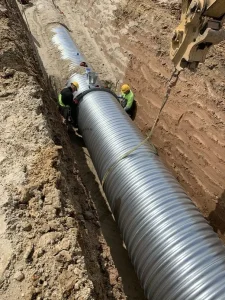
Installation efficiency improved because individual sections could be connected quickly while maintaining a watertight seal through the use of adhesive PTFE gaskets.
The focus on maintainability reflects principles found throughout NCSPA’s Technical Resources and Design Data Sheets, where long-term performance and serviceability remain critical design considerations.
Designed for Challenging Site Conditions
The project site featured a high groundwater table, creating additional engineering challenges.
To prevent groundwater infiltration and preserve available storage capacity, the retention tank was designed as a completely watertight system. This approach ensured that external groundwater could not compromise the effectiveness of the retention structure.
The completed installation utilized spirally corrugated steel pipe with an internal diameter of approximately 55 inches. The total installed length exceeded 1.3 miles, creating a substantial underground stormwater management network capable of handling the site’s runoff requirements.
The project’s emphasis on effective stormwater management aligns with findings presented in NCSPA’s Storm Water Management System Case Study, which highlights the value of engineered underground storage systems in managing runoff and improving site performance.
Sustainability Through Underground Stormwater Infrastructure
Beyond hydraulic performance, the retention system also delivered important environmental benefits.
The steel structure provides long service life, durability, and resilience while remaining fully recyclable at the end of its service life. These characteristics help support sustainable infrastructure objectives while reducing long-term environmental impacts.
The project’s sustainability focus mirrors many of the concepts discussed throughout NCSPA’s Sustainability initiative and Studies & Reports library, where lifecycle performance and environmental stewardship remain central themes.
Engineers evaluating the broader environmental impact of infrastructure projects can also utilize NCSPA’s Environmental Calculator to better understand sustainability benefits.
Supporting Modern Stormwater Management
As communities continue seeking efficient ways to manage runoff, underground retention systems are becoming increasingly important.
By combining significant storage capacity, controlled discharge, efficient maintenance access, and long-term durability, the Kaunas project demonstrates how modern stormwater infrastructure can protect sites while supporting sustainable development.
The project stands as an excellent example of how corrugated steel systems can provide practical solutions to complex rainwater retention challenges while helping communities manage stormwater more effectively.