By: Atlantic Industries Limited
Quick Project Summary
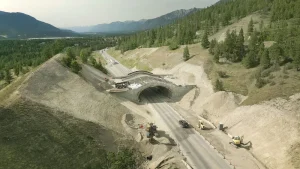
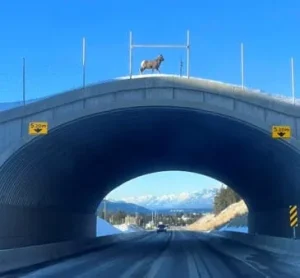
This award-winning wildlife crossing overpass in Radium Hot Springs, British Columbia, was named The NCSPA Going Green Project of the Year. Developed to address a 15% annual decline in bighorn sheep due to vehicle collisions, the structure reconnects fragmented habitat while improving roadway safety. Using a corrugated steel arch system, the design delivers long-term durability, efficient installation under live traffic, and a naturalized crossing that wildlife are already using.
A Landmark Wildlife Crossing Overpass with Real Impact
Right away, this project stands apart. It is the 2026 Going Green Project of the Year Winner, and it earns that title without question. The wildlife crossing overpass in Radium Hot Springs, British Columbia, tackles a serious problem with precision and purpose.
For years, vehicle strikes reduced the local bighorn sheep population by roughly 15 percent annually. However, instead of accepting that loss, this project reimagined infrastructure as part of the solution.
Engineering a Wildlife Crossing Overpass That Works with Nature
Of course, a project like this demands more than good intentions. It requires smart engineering.
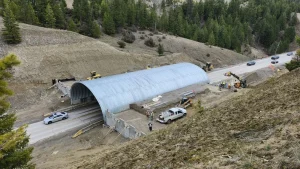
The wildlife crossing overpass features a corrugated steel Super-Cor arch with a span of about 55 feet, a rise of 21 feet, and a length of 115 feet. Meanwhile, ultra-deep corrugations provide strength while maintaining flexibility, which proved essential for the site’s poor foundation soils.
Additionally, construction took place under active traffic conditions. Crews completed most work during lane drops and night closures, which minimized disruption. That alone is impressive, but it gets better.
A geomembrane system prevents groundwater infiltration, protecting the structure long term. Furthermore, mechanically stabilized earth headwalls reduce the overall structure length while maintaining stability.
In short, this wildlife crossing overpass blends durability, efficiency, and environmental sensitivity into one cohesive design.
Guiding Wildlife to Safety with Smart Design
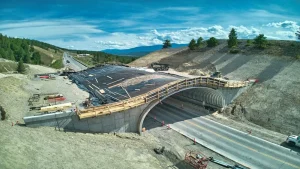
However, the structure itself is only part of the story. The surrounding system plays an equally critical role.
To ensure effectiveness, the project includes approximately 3.7 miles of wildlife fencing. These barriers guide animals toward the crossing instead of the roadway. At the same time, guide gates reinforce natural movement patterns.
Above the structure, a carefully designed “wildscaped” cover creates a natural environment. Expanded polystyrene berms also help reduce traffic noise, which encourages animals to use the crossing.
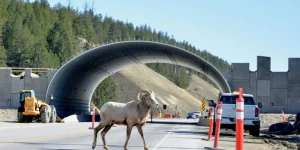
As a result, the wildlife crossing overpass feels less like infrastructure and more like an extension of the landscape. Not surprisingly, bighorn sheep are already using it regularly.
A Wildlife Crossing Overpass Built Through Collaboration
Equally important, this project demonstrates what happens when the right partners come together.
The British Columbia Ministry of Transportation and Infrastructure led the effort, but they did not work alone. Instead, the project brought together engineering firms, conservation groups, Indigenous communities, and private organizations.
Because of that collaboration, the wildlife crossing overpass reflects shared priorities. It improves public safety, protects wildlife, and respects cultural and environmental considerations.
That level of coordination is not easy. Still, it is exactly what made this project successful.
Why This Wildlife Crossing Overpass Matters for the Future
Ultimately, this project goes beyond a single location.
The wildlife crossing overpass reduces collisions, saves wildlife, and strengthens ecological corridors. At the same time, it proves that corrugated steel solutions can support sustainable infrastructure goals.
More importantly, it sets a precedent. Engineers and decision-makers now have a proven model that balances performance with environmental responsibility.
That is why this project earned the Going Green Project of the Year recognition. It does not just solve a problem. It shows a better way forward.
Related Stories
2024 Project of the Year – Going Green: NM DOT I-25
2024 Project of the year – Resiliency: BF 84211 Stoney Nakoda Exshaw Wildlife Arch
2022 Project of the Year Winner – Going Green: High Speed Railway Ecological Overpass