By: Contech Engineered Solutions
Project Summary
The 2024 NCSPA Going Green Project of the Year created two wildlife crossing bridges beneath Interstate 25 near Raton Pass, helping reduce wildlife-vehicle collisions while improving habitat connectivity. The buried bridge structures provide a long-term solution that benefits both motorists and wildlife in a region known for its diverse animal populations.
Protecting Wildlife Along a Critical Transportation Corridor
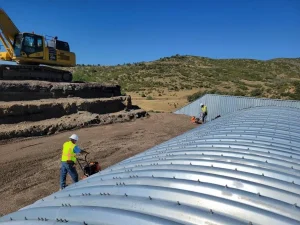
Interstate 25 serves as a major transportation route connecting northeastern New Mexico and southern Colorado. The 21.8-mile section near Raton Pass passes through an area known for its scenic landscapes and abundant wildlife, including elk, deer, black bear, bighorn sheep, pronghorn, and mountain lion.
While these species are an important part of the region’s ecosystem, they also create challenges for motorists. Wildlife-vehicle collisions remain a significant concern throughout the United States, resulting in substantial property damage, injuries, and threats to wildlife populations.
Recognizing these challenges, the New Mexico Department of Transportation (NMDOT) partnered with the New Mexico Department of Game and Fish through the Wildlife Corridors Act to identify opportunities to improve driver safety while maintaining critical wildlife movement corridors.
Submitted by Contech Engineered Solutions, the project earned recognition as the 2024 NCSPA Going Green Project of the Year.
A Buried Bridge Solution for Wildlife Connectivity
Rather than relying on traditional bridge construction, NMDOT selected custom structural plate buried bridges designed specifically for wildlife crossings.
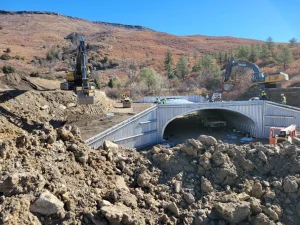
The project included two animal passage structures, one beneath the northbound lanes and one beneath the southbound lanes of Interstate 25. These crossings were designed to meet wildlife openness ratio requirements while providing a safe and effective route beneath the highway.
Buried bridge solutions continue to gain popularity for wildlife crossing applications because they provide large, natural passageways while minimizing long-term maintenance requirements. Similar approaches have been successfully used on projects such as Seprivatn Reindeer Crossing in Norway and Bigelow Gulch Fish Passage, where transportation needs and environmental stewardship worked hand in hand.
Engineers evaluating similar applications can review NCSPA’s Design Data Sheets and Technical Resources for additional structural and environmental design information.
Designed for Wildlife and Long-Term Performance
Although bidding occurred in late 2020, construction of the first crossing began in the fall of 2021.
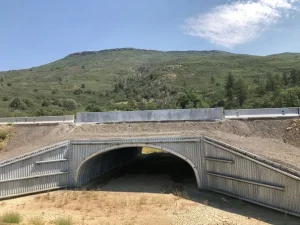
Both buried bridges utilize identical span, rise, gage, and corrugation configurations. The southbound structure measures approximately 64 feet long, while the northbound structure measures approximately 70 feet long. Each crossing features a span exceeding 20 feet, qualifying them as bridge structures within New Mexico’s bridge inventory.
The structures consist of deep corrugated steel structural plate box culverts designed to meet AASHTO M167 requirements. Headwalls and wingwalls were fabricated from galvanized steel structural plate, creating a durable system capable of supporting long-term transportation and environmental objectives.
The use of structural plate systems for wildlife crossings continues to expand as agencies seek solutions that balance infrastructure needs with environmental conservation goals. Similar structural plate applications can be seen in Bridge Over the Chudowski Stream, where buried bridge technology provided an efficient replacement for aging infrastructure.
Improving Driver Safety Through Wildlife Corridors
Wildlife crossings provide benefits that extend beyond conservation.
By creating designated crossing locations beneath the highway, the project helps reduce the likelihood of animals entering traffic lanes. This can improve driver safety while reducing vehicle damage and associated costs from wildlife collisions.
The project also helps preserve habitat connectivity, allowing wildlife populations to continue moving naturally throughout the region. Maintaining these migration routes is especially important for larger species that depend on expansive territories.
Transportation agencies increasingly recognize wildlife crossings as valuable infrastructure investments because they improve roadway safety while supporting broader environmental objectives. Additional information on sustainable infrastructure solutions can be found through NCSPA’s Sustainability resources and Studies & Reports.
A Model for Future Wildlife Crossing Projects
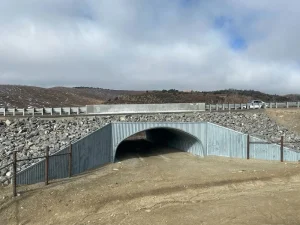
The Interstate 25 wildlife crossing project demonstrates how transportation infrastructure can work alongside environmental stewardship.
By utilizing buried bridge technology, NMDOT created durable wildlife crossings that improve driver safety, maintain habitat connectivity, and support long-term infrastructure performance. The project serves as a strong example of how innovative engineering can help agencies address transportation and environmental challenges simultaneously.
As wildlife crossing programs continue to expand across North America, projects like this provide a proven model for balancing mobility, safety, and conservation.