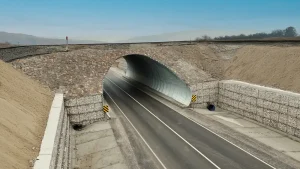
Bridge owners and transportation agencies across North America face the growing challenge of replacing aging infrastructure while minimizing costs, construction time, and traffic disruptions. Corrugated steel structural plate systems provide an economical alternative to conventional short-span bridges by combining exceptional structural performance with rapid installation, long service life, and minimal maintenance requirements.
Whether replacing deteriorating bridges, constructing new stream crossings, or improving environmental connectivity, corrugated steel pipe and structural plate systems deliver engineered solutions for highway, railroad, municipal, agricultural, industrial, and recreational infrastructure. Available in a wide range of spans, profiles, and protective coating systems, these flexible structures are designed to perform for generations.
The National Corrugated Steel Pipe Association (NCSPA) provides engineers, transportation agencies, and designers with the technical resources needed to specify buried bridges and structural plate systems for virtually any short-span bridge application.
Why Engineers Choose Corrugated Steel Bridges
Corrugated steel bridge systems provide numerous advantages over conventional bridge construction while maintaining the structural performance required for modern transportation infrastructure.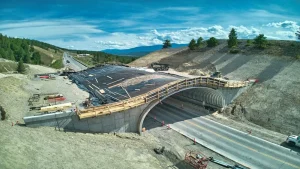
Benefits include:
- Faster construction with reduced road closures
- Lower initial and life cycle costs
- Excellent structural strength and durability
- Long service life with multiple protective coating options
- Minimal maintenance requirements
- Sustainable construction using recycled steel
- Environmentally friendly open-bottom crossing solutions
- Flexible designs for a wide range of spans and site conditions
Structural Strength & Performance
Corrugated steel structural plate bridges develop their strength through engineered soil-structure interaction. Rather than resisting loads independently, the surrounding compacted backfill works together with the steel structure to efficiently distribute highway, railway, and earth loads.
This proven design approach allows corrugated steel bridge systems to accommodate deep fills, heavy live loads, and large spans while maintaining exceptional long-term structural performance. Available in numerous plate profiles and structural configurations, buried bridges can often replace conventional bridge structures at a fraction of the overall project cost.
Accelerated Construction & Lower Costs
One of the greatest advantages of corrugated steel bridge systems is construction speed. Prefabricated structural plate components arrive ready for assembly, allowing installation in days rather than weeks or months required for many conventional bridge projects.
Shorter construction schedules reduce:
- Traffic disruptions
- Detour costs
- Labor expenses
- Equipment costs
- Environmental impacts
Combined with reduced foundation requirements and simplified installation, corrugated steel often provides one of the lowest life cycle costs for short-span bridge replacement.
Long Service Life & Protective Coatings
Bridge owners demand infrastructure that performs for decades under demanding environmental conditions. Corrugated steel structural plate systems are available with multiple protective coating options, including galvanized steel, Aluminized Type 2 steel, and polymer-coated steel for applications requiring extended durability.
Service life depends on environmental conditions, water chemistry, abrasion, and coating selection. The NCSPA provides Service Life Calculators and engineering guidance to help designers evaluate long-term performance for specific project conditions.
Minimal Maintenance
Compared to conventional bridge construction, corrugated steel buried bridges require significantly less routine maintenance. Without bridge decks, expansion joints, bearings, or approach slabs, owners benefit from reduced inspection requirements and lower maintenance costs throughout the structure’s service life.
Many installations continue performing successfully for decades with minimal intervention, contributing to outstanding life cycle value.
Environmental Benefits
Corrugated steel buried bridges support sustainable infrastructure by preserving natural waterways and reducing impacts to surrounding ecosystems.
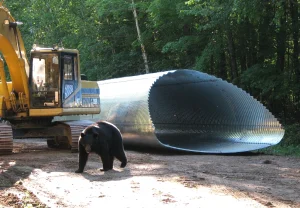
Open-bottom bridge designs:
- Preserve natural streambeds
- Improve fish passage
- Maintain aquatic habitat
- Reduce stream disturbance
- Support environmental permitting requirements
Because many installations require less excavation and shorter construction schedules than conventional bridges, environmental impacts during construction are also minimized.
Common Bridge Applications
Corrugated steel bridge systems are widely used for:
- Highway bridge replacement
- County and municipal road crossings
- Railroad crossings
- Forest service roads
- Agricultural crossings
- Recreational trails
- Mining operations
- Park infrastructure
- Wildlife crossings
- Fish passage projects
Engineering Resources
The NCSPA provides comprehensive engineering guidance for buried bridges and structural plate systems, including design manuals, Technical Notes, engineering calculators, research reports, and project case studies.
Continue your research:
- Steel Structural Plate
- Steel Box Culverts
- Fish Passage Solutions
- Structural Plate Service Life Calculator
- Protective Coating Systems
- Project Spotlights & Case Studies
Whether you’re replacing an aging bridge, designing a new stream crossing, or evaluating life cycle costs, the NCSPA provides the technical resources needed to specify corrugated steel with confidence.
Frequently Asked Questions
What is a buried bridge?
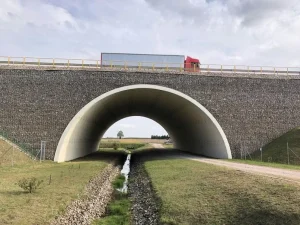
A buried bridge is a flexible structural system that uses corrugated steel structural plates and engineered backfill to support roadway loads while spanning waterways, roads, railways, or other crossings.
What are the advantages of corrugated steel bridges?
Corrugated steel bridges provide faster installation, lower life cycle costs, excellent structural performance, long service life, minimal maintenance, and sustainable construction compared to many conventional bridge systems.
How long do buried bridges last?
Service life depends on environmental conditions and the protective coating selected. Properly designed systems routinely provide decades of reliable performance, with coating options available for extended service life.
Can structural plate bridges support highway traffic?
Yes. Corrugated steel structural plate bridges are engineered to safely support highway, railway, and construction loading when designed according to applicable engineering standards.
Are buried bridges environmentally friendly?
Yes. Open-bottom buried bridges preserve natural streambeds, improve fish passage, reduce habitat disturbance, and often simplify environmental permitting compared to conventional bridge construction.