By: Lane Enterprises, Inc.
Project Summary
The 2023 NCSPA Rehabilitation Project of the Year replaced an aging Union Pacific timber trestle without interrupting rail service. The project showcased the successful use of polymer-coated structural plate technology while allowing trains to continue operating throughout construction.
Replacing Aging Railroad Infrastructure
Railroad timber trestles played a significant role in rail transportation throughout the nineteenth century. While many of these structures continue to serve today, railroads across North America increasingly face the challenge of rehabilitating or replacing aging crossings that have reached the end of their service lives.
For rail operators, replacing these structures is rarely straightforward. Closing a rail line can disrupt freight movement, create scheduling challenges, and generate significant economic impacts. As a result, railroads often seek solutions that allow rehabilitation or replacement work to occur while rail service remains active.
The Union Pacific Bridge identified as Rockport Subdivision Culvert 11.50 presented exactly this challenge. The existing bridge required replacement, but maintaining uninterrupted rail operations remained a critical project requirement.
Submitted by Lane Enterprises, Inc., the project ultimately became a showcase for innovation in railroad bridge replacement and rehabilitation.
Keeping Trains Moving During Construction
The project’s primary objective was clear: replace the existing structure without disrupting rail traffic.
Union Pacific and the project team needed a solution that could be installed efficiently while maintaining the integrity of the active rail corridor. Traditional bridge replacement methods often require extended closures and complex staging operations. Those options were not desirable for a heavily utilized rail line.
Instead, the team selected a buried bridge approach utilizing structural plate technology. This strategy allowed construction to proceed while rail operations continued above, minimizing impacts to freight transportation and reducing overall project disruption.
Projects like this demonstrate why buried bridge systems continue gaining attention for transportation infrastructure applications where maintaining operations is essential. Similar approaches have been used on projects such as the Exit 41 Interchange and the Bridge Over the Chudowski Stream, where minimizing disruptions during construction was a key project objective.
A New Generation of Polymer-Coated Structural Plate
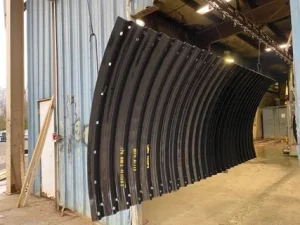
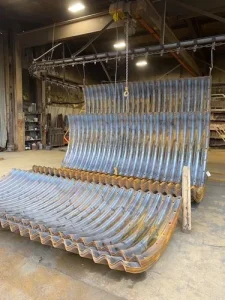
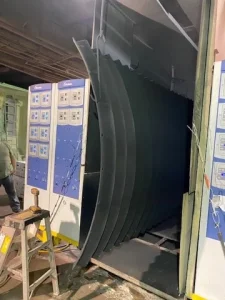
The railroad industry has a long history of utilizing corrugated steel pipe and structural plate systems. However, this project presented a unique challenge.
Union Pacific’s standards required polymer-coated materials, and project specifications called for structural plate dimensions and coating requirements that were not readily available through existing industry offerings. At the time, engineers and specifiers were largely unaware that a major advancement had recently occurred within the industry.
In 2020, ASTM published ASTM A1113, establishing standards for polymer-coated corrugated steel structural plate used in field-bolted pipe, pipe-arches, and arches. The development created new opportunities for structural plate applications in demanding environments. The successful use of polymer-coated structural plate continues to expand opportunities for rehabilitation and bridge replacement projects. Similar innovations have supported projects such as the Yellow Mill Bridge Rehabilitation, where owners sought durable, long-term transportation infrastructure solutions.
Lane Enterprises played a significant role in the development and manufacturing of polymer-coated structural plate products. With coating capabilities located in Carlisle, Pennsylvania, the company was uniquely positioned to support the project’s requirements.
Engineers evaluating similar applications can explore NCSPA’s Technical Resources, Design Data Sheets, and research on Polymer-Coated Structural Plate and Fasteners for additional information.
Building a Buried Bridge Beneath Active Tracks
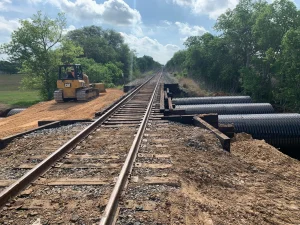
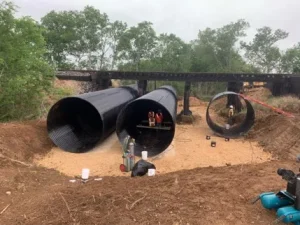
The final design utilized three 84-foot-long, 120-inch structural plate arches to replace three of the four spans within the existing timber trestle.
Construction proceeded with the structural plate components field-bolted into place beneath the active railroad. Once assembled, crews backfilled around the structure and utilized flowable fill beneath the tracks to complete the embedment process.
One of the most remarkable aspects of the project was that rail service continued throughout construction. The buried bridge solution eliminated the need for extensive rail closures while providing a durable replacement structure capable of supporting future operations.
The existing timber trestle effectively became a buried component within the completed system, while the new structure assumed the long-term structural role.
A Model for Future Railroad Bridge Replacement
Beyond replacing a single crossing, the project demonstrated how emerging materials and innovative design approaches can help railroads address aging infrastructure more efficiently.
The successful use of polymer-coated structural plate expanded the possibilities for future railroad bridge replacement projects where durability, corrosion protection, and constructability are important considerations. The project also highlighted the advantages of buried bridge construction when maintaining active transportation corridors is a priority.
Design professionals evaluating long-term durability can utilize NCSPA’s Structural Plate Service Life Calculator and review additional performance data within NCSPA’s Studies & Reports.
The Union Pacific Bridge Replacement project earned recognition as the 2023 NCSPA Rehabilitation Project of the Year because it successfully combined innovation, constructability, and operational efficiency. The result is a durable buried bridge solution that will continue supporting railroad infrastructure for decades to come.