By: Contech Engineered Solutions
Project Summary
After severe flooding washed out a culvert beneath Oregon Highway 47, ODOT needed a permanent replacement that restored fish passage without disrupting a critical transportation route. A structural steel plate buried bridge delivered the hydraulic capacity, rapid installation, and cost efficiency needed to complete the project within a restricted construction window.
When Flooding Takes Out a Critical Highway
In January 2022, severe flooding sent Messing Creek surging beneath Oregon Highway 47 near Mist, Oregon. The existing culvert at Milepost 11.6 washed out, causing the highway above it to fail.
Restoring the road quickly was essential.
Highway 47 provides access to a local elementary school and homes throughout the area. It also serves as an important logging route for the region’s timber industry.
As an emergency measure, crews installed three 6-foot culverts to restore the highway. The temporary solution reopened the road, but it did not meet environmental requirements for fish passage.
Oregon Department of Transportation Region 2 then began developing a permanent solution that could improve stream passage while maintaining this important transportation connection.
Designing for Messing Creek and Fish Passage
Messing Creek provides critical fish habitat, making environmental performance a major part of the replacement design.
The project also faced a strict construction constraint. In-water work could only occur between July 1 and August 31.
That short window made construction speed especially important.
ODOT evaluated two alternatives: a structural steel plate open-bottom arch and a precast slab bridge. The agency ultimately selected the buried structural steel plate alternative because it offered lower costs and a faster construction schedule while meeting the project’s hydraulic and structural requirements.
The open-bottom design also supports the goals of modern fish passage solutions, where maintaining or simulating natural stream conditions can improve aquatic connectivity.
ODOT’s broader Fish Passage Program recognizes that highway culverts and bridges can create migration barriers. Improving these crossings can reconnect fish with important upstream and downstream habitat.
A Custom Structural Steel Plate Solution
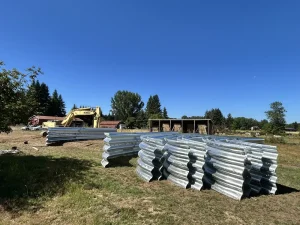
The permanent crossing required a substantial structure.
The custom structural steel plate bridge spans 40 feet, 7 inches and rises approximately 9 feet, 6 inches. The structure extends 85 feet beneath the roadway, providing the opening required for Messing Creek while supporting traffic above.
Contech Engineered Solutions submitted the project and fabricated the high-strength steel structure.
The project demonstrates the flexibility available with corrugated steel bridges. Structural plate systems can accommodate custom spans and site conditions while creating open-bottom crossings that preserve the stream channel below.
That combination was particularly valuable at Messing Creek, where transportation, hydraulic, environmental, and construction requirements all had to work together.
From Plates to Bridge in Just Over a Day
The installation schedule shows one of the most significant advantages of the selected system.
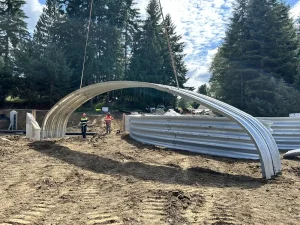
Crews assembled the entire structural steel plate structure during one full working day and three hours the following day.
Once assembled, crews carefully monitored the structure’s shape throughout backfilling. The contractor maintained balanced fill levels on both sides while progressing upward and over the structure.
Rapid assembly helped the project team work within the limited in-water construction period while meeting emergency funding constraints.
This type of construction efficiency is one reason structural plate can provide an effective alternative for bridge replacements where extended closures or construction schedules create additional challenges.
Restoring More Than a Road
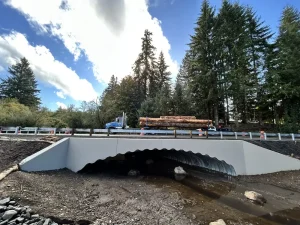
The completed Messing Creek project solved two problems at once.
For the community, the new crossing restored a safer, permanent connection along Highway 47. Local residents regained reliable access, logging traffic could continue using the corridor, and children could once again travel safely to school.
For the environment, the replacement improved fish passage through Messing Creek rather than simply recreating the culvert configuration that existed before the flood.
The project demonstrates how corrugated steel solutions can help transportation agencies balance infrastructure resilience with environmental goals.
What began with a flood-damaged highway ultimately became an opportunity to build a crossing better suited to both the community above it and the aquatic habitat below.
Related Project Stories
Fish passage and transportation infrastructure often share the same challenge: maintaining a reliable crossing without creating a barrier below it. The Bigelow Gulch Fish Passage demonstrates another approach to maintaining aquatic connectivity with corrugated steel.
Structural plate has also played a role in Oregon transportation projects for years. The ODOT Region 2 Pipe Procurement project used deep corrugated structural plate for a buried bridge designed to accommodate hydraulic and wildlife passage requirements.
For another example of structural plate addressing an aging transportation crossing, the Norfolk Southern Bridge Over Stoney Creek shows how steel structural plate can provide an economical alternative for challenging bridge projects.