Project Summary
A value-engineered corrugated steel pipe-arch system provided the hydraulic capacity needed for Florida’s Turnpike expansion. The solution also reduced joints, simplified placement, and improved constructability along the busy corridor.
Florida’s Turnpike Expansion Calls for Major Drainage Improvements
Florida’s Turnpike, designated State Road 91, carries significant commuter and freight traffic throughout South Florida. Continued population growth and increasing traffic demand have driven major improvements along the corridor. These include widening several segments of the mainline from four lanes to eight lanes.
In Palm Beach County, one segment includes widening the Turnpike between Southern Boulevard and Okeechobee Boulevard. The work also includes interchange reconstruction, bridge improvements, and upgraded drainage infrastructure.
Those improvements created a significant drainage challenge. The expanded roadway footprint required a high-capacity system that could satisfy strict hydraulic and structural requirements.
The Florida Department of Transportation served as the project owner and engineer, with Asphalt Group, Inc. handling construction. NCSPA member Contech Engineered Solutions fabricated and supplied the corrugated steel pipe-arch system.
Value Engineering the Original Concrete Box Culvert Design
The original project design specified reinforced concrete box culverts to convey stormwater beneath the widened roadway. However, FDOT remained open to value-engineered alternatives that could provide the required hydraulic capacity while improving constructability.
Several requirements shaped the final solution. The alternative needed hydraulic equivalency to the specified box culvert. Minimum cover requirements favored a lower-profile structure. Additionally, the material thickness had to meet requirements established in the project plans.
This is not the first NCSPA project where teams found an opportunity to reconsider an original concrete design. At The Cubes at Inland Woods, engineers evaluated corrugated steel against an originally specified reinforced concrete drainage system.
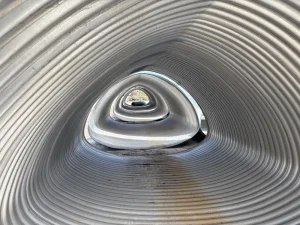
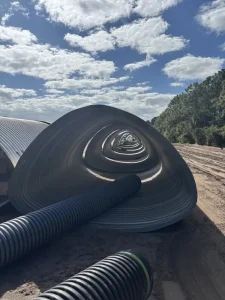
For the SR-91 expansion, the project team ultimately selected a 5 × 1 corrugation pipe-arch manufactured from Aluminized Type 2 steel. Contech supplied 2,140 linear feet of 137-inch by 87-inch, 10-gauge pipe-arch.
The conversion provided an alternative that could meet the project’s hydraulic and structural requirements while addressing construction constraints along the Turnpike.
A Lower-Profile Solution for Limited Cover
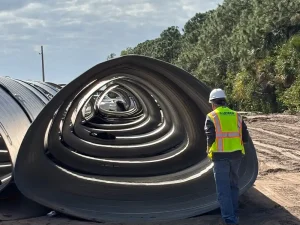
The pipe-arch geometry addressed two major requirements at once. It provided the necessary hydraulic capacity while maintaining a lower structural profile for locations with limited cover.
This ability to provide waterway area within constrained vertical space makes corrugated steel pipe-arch useful where a comparable round pipe may not fit.
Similar site constraints shaped the Butler County SW Haverhill Road project. There, a height restriction prevented the use of a large-diameter round corrugated steel culvert. The project instead used two arched steel culverts to accommodate the available space and water flow.
The SR-91 pipe-arch also incorporated Aluminized Type 2 steel. Engineers evaluating coating options and anticipated durability can use The NCSPA’s Service Life Calculator to explore how environmental conditions affect corrugated steel pipe service-life estimates.
Longer Pipe Sections Simplify Highway Construction
Constructability became especially important because work was occurring adjacent to one of Florida’s busiest highways. Equipment size, safety, and installation duration all influenced the project team’s evaluation.
The corrugated steel pipe-arch arrived in 20-foot sections. The project submission compares those sections with typical 6-foot concrete box sections. Longer sections reduced the total number of joints required across the 2,140-foot system.
The lighter steel sections also allowed Asphalt Group to use an excavator for placement. The project submission notes that a crane would typically be required to place large concrete box culverts.
Fewer joints, simplified equipment requirements, and shorter manufacturing lead times helped reduce installation duration.
Minimizing disruption can be particularly important for drainage work along active transportation corridors. Another Florida project, the Miami-Dade Emergency Reline, used an Aluminized Type 2 corrugated steel solution when crews needed to address a failing culvert while avoiding a major roadway closure.
For contractors preparing similar projects, The NCSPA provides installation specifications for corrugated steel pipe and pipe-arch systems.
2,140 Feet of Corrugated Steel Pipe-Arch for SR-91
The drainage system includes 2,140 linear feet of 137-inch by 87-inch Aluminized Type 2 corrugated steel pipe-arch. It provides the hydraulic capacity required to support the expanded Turnpike footprint.
The project also demonstrates how value engineering can address several construction challenges at once. Rather than evaluating material alone, the team considered hydraulic performance, cover limitations, equipment needs, section lengths, safety, and installation duration.
Florida has a long history of using corrugated steel for transportation drainage. The 14th Street Improvements project in Ocala dates to 1986 and converted an originally specified reinforced concrete storm sewer to Aluminized Type 2 corrugated steel pipe. A 2016 inspection found the system remained in good condition and performing as expected.
On SR-91, the value-engineered corrugated steel pipe alternative met the project’s hydraulic and structural requirements while improving constructability along a demanding highway corridor.
The project gives engineers, contractors, and transportation agencies another example of how corrugated steel culverts can provide flexibility when roadway expansion, drainage capacity, and site constraints must all be addressed together.