By: TrueNorth Steel
Project Summary
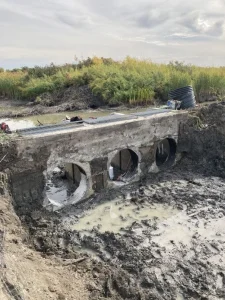
TrueNorth Steel helped restore aging water control structures at Minnesota’s Agassiz National Wildlife Refuge using custom polymer-coated steel pipe and innovative flange adapters. The project improved hydraulic performance, extended service life, and created a rehabilitation solution that has since been adopted on additional refuge projects.
The U.S. Fish and Wildlife Service manages thousands of acres of wetlands at the Agassiz National Wildlife Refuge in north-central Minnesota. Maintaining reliable water control structures is essential for protecting wildlife habitat, managing seasonal water levels, and supporting the refuge’s long-term conservation mission.
When several outlet structures installed during the 1970s reached the end of their service life, the U.S. Fish and Wildlife Service turned to TrueNorth Steel to develop a rehabilitation solution that could improve performance without requiring complete replacement of the existing concrete structures.
Restoring Aging Water Control Structures
Many of the refuge’s original outlet structures had deteriorated after decades of service. Previous rehabilitation attempts using both steel casing pipe and HDPE pipe created challenges when connecting the replacement pipe to the existing concrete walls.
Rather than continuing to adapt conventional solutions, TrueNorth Steel developed a custom-fabricated flange adapter that created a secure connection between the existing concrete structure and the new outlet pipe. The design helped prevent washout while providing a positive joint connection that minimized leakage and improved long-term reliability.
Engineers working on similar rehabilitation projects can reference NCSPA’s Technical Resources and Design Data Sheets for additional guidance.
Improving Hydraulic Performance
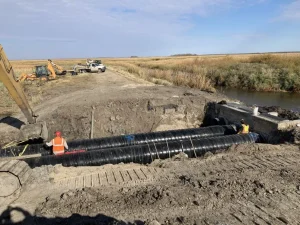
Once the deteriorated outlet pipes were removed, crews discovered that the existing concrete openings could not accommodate a full 42-inch replacement pipe.
Instead of sacrificing hydraulic capacity, TrueNorth Steel engineered a custom 40-inch inside-diameter solution that maximized the available waterway opening. The revised design maintained excellent hydraulic performance while fitting within the existing structure, avoiding more extensive reconstruction.
Hydraulic performance is a critical consideration for water control infrastructure. Similar principles are explored through NCSPA’s Water Quality System Calculator and related stormwater design resources.
Polymer-Coated Steel Provides Long-Term Performance
The project utilized Polymer-Coated Spiral Rib pipe because of its excellent corrosion resistance, long service life, and hydraulic efficiency. The material’s Manning’s n value of 0.012 supports efficient water flow while providing outstanding durability in demanding wetland environments.
Crews also installed gasketed positive joints with rod-and-lug band connectors to further reduce leakage and improve overall system performance.
Owners evaluating long-term durability can compare expected performance using NCSPA’s Service Life Calculator and additional research available through NCSPA’s Studies & Reports.
A Solution Worth Repeating
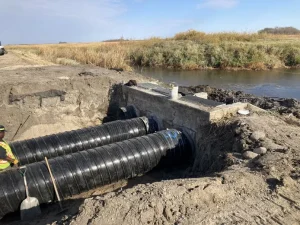
The rehabilitation proved so successful that the U.S. Fish and Wildlife Service adopted the custom flange adapter design for additional steel outlet control structures throughout the refuge.
Rather than creating a one-time repair, the project established a repeatable rehabilitation approach that improves reliability while extending the service life of critical water management infrastructure. Similar rehabilitation success stories can be seen in the Buckingham Creek Restoration, where infrastructure improvements supported long-term environmental goals, and the Florida Canal Water Control Project, which demonstrated innovative steel solutions for agricultural water management.
For more information about the refuge and its conservation efforts, visit the U.S. Fish & Wildlife Service’s Agassiz National Wildlife Refuge page.