By: Atlantic Industries Limited
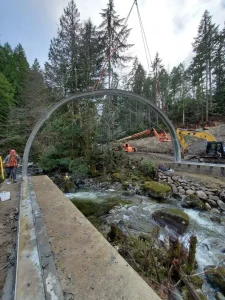
Project Summary
Western Canada’s first deep corrugated buried structural steel plate bridge transformed Holland Creek into a safe multi-use crossing while preserving the surrounding natural landscape. Submitted by Atlantic Industries Limited, the project demonstrates how buried bridge technology can improve transportation access with minimal environmental impact.
Holland Creek is one of the defining natural features of Ladysmith, British Columbia. Its forested setting and extensive trail network make it a popular destination for residents and visitors alike.
When community leaders planned a new residential development, they needed a crossing that would improve access without sacrificing the area’s natural character. Rather than constructing a conventional bridge, the project team selected an innovative buried bridge solution that blended engineering performance with environmental stewardship. The result became Western Canada’s first deep corrugated buried structural steel plate bridge.
Engineering a New Kind of Buried Bridge
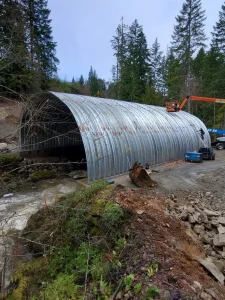
Manufactured by Atlantic Industries Limited, the crossing utilizes two Bolt-A-Plate structural plate tunnels measuring approximately 14 feet in diameter. Together, they form a deep corrugated buried bridge capable of supporting roadway traffic while maintaining the natural stream corridor below.
The bridge spans approximately 63.5 feet, rises nearly 24.5 feet above the creek, and incorporates a mechanically stabilized earth (MSE) wall that integrates the structure into the surrounding landscape.
Projects utilizing structural plate technology continue to demonstrate the flexibility of buried bridge systems. Engineers evaluating similar applications can reference NCSPA’s Design Data Sheets and Technical Resources for additional guidance.
Preserving the Natural Landscape
Originally, the project team considered constructing a conventional bridge. However, additional study showed that a buried bridge would better preserve the forested environment while creating access to the new residential development.
The completed crossing supports a 4.1-mile recreational trail system that winds along Holland Creek, allowing pedestrians and cyclists to continue enjoying the area’s forests, mountain scenery, and waterways with minimal disruption to the surrounding habitat.
This balance between infrastructure and environmental stewardship has become a recurring theme in projects like the New Mexico I-25 Wildlife Crossing and the Trinity County Culvert Repairs, where steel infrastructure improved access while protecting sensitive natural resources.
Built to Disappear into the Environment
One of the project’s greatest strengths is what visitors often don’t notice.
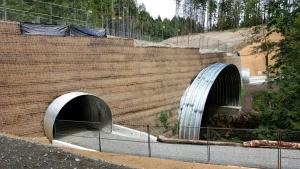
As vegetation matures around the mechanically stabilized earth walls, the buried bridge gradually blends into the surrounding forest. Unlike conventional bridge structures that remain visually prominent, the completed installation minimizes its presence while continuing to provide safe, reliable transportation access.
The structural plate design also reduces long-term maintenance requirements while providing exceptional durability for the community.
Owners comparing long-term bridge alternatives can utilize NCSPA’s Service Life Calculator and review additional performance research in NCSPA’s Studies & Reports.
A Model for Future Community Infrastructure
The Holland Creek Crossing demonstrates how buried bridge technology can solve transportation challenges while respecting the surrounding environment.
By replacing a conventional bridge with a deep corrugated buried bridge, the project improved community access, preserved recreational opportunities, and created an infrastructure solution designed to serve Ladysmith for decades.
For additional information about Holland Creek and community planning initiatives, visit the Town of Ladysmith website.