Project Summary
A six-cell corrugated steel bridge replaced an aging reinforced concrete crossing in Kastamonu, Türkiye, to improve river flow and flood safety. Designed and installed by Culvert Tech, the structure provides a 131-foot total span and was assembled in just six days.
Replacing a Crossing That Could No Longer Keep Up
River crossings must do more than carry loads. They also need to accommodate the water moving beneath them.
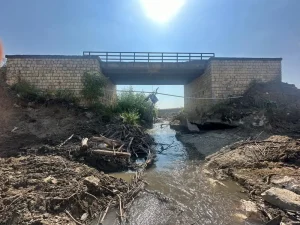
In Kastamonu, Türkiye, an existing reinforced concrete bridge had served the region for many years. However, increased hydraulic loads and changes in the river’s flow regime gradually exceeded the crossing’s capabilities. Long-term climatic conditions added to those challenges.
The General Directorate of State Hydraulic Works of the Republic of Türkiye, known as DSİ, initiated reconstruction of the crossing. The goal was to improve flood safety while increasing the river’s discharge capacity.
Instead of replacing the existing bridge with another conventional concrete structure, the project used a multi-span corrugated steel bridge.
Culvert Tech designed the new crossing and served as contractor. Hengshui Yitong fabricated the corrugated steel structure.
The project demonstrates how corrugated steel bridge systems can address structural and hydraulic demands within the same design.
Six Cells Create a Larger Hydraulic Opening
The new crossing uses six closed-section cells, creating a total span of approximately 131 feet.
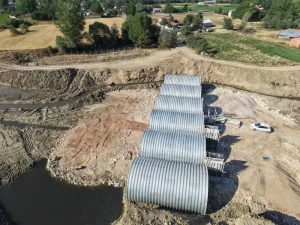
Each cell measures approximately 20 feet, 7 inches wide by 15 feet, 8 inches high. The plates feature a corrugation profile of approximately 15 inches by 5.5 inches.
That configuration creates a substantially larger hydraulic opening for the river.
Greater flow capacity helps reduce flood risk while preserving the river’s natural flow regime. The design also supports ecosystem continuity within the surrounding environment.
Hydraulic capacity often drives the design of large stream and river crossings. Corrugated steel systems can be configured in multiple shapes and spans to meet those site-specific demands. Engineers can explore similar applications through The NCSPA’s corrugated steel culvert resources.
The project also shares similarities with Rebuilding for Resilience in Düzce, another Culvert Tech project in Türkiye. There, a larger corrugated steel crossing addressed hydraulic limitations exposed by severe flooding.
Soil-Steel Interaction Supports the Crossing
The Kastamonu bridge does not rely on the steel structure alone.
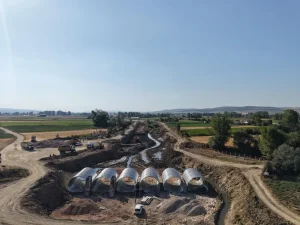
Instead, the system uses engineered soil-steel interaction. The surrounding compacted backfill works with the corrugated steel structure to distribute loads.
That relationship allows flexible buried structures to support significant embankment loads while maintaining structural performance. The project team performed controlled backfilling and compaction while accounting for seasonal and meteorological conditions.
The same engineering principle supports many structural plate systems, particularly where large spans and demanding loading conditions require adaptable designs.
For engineers evaluating these systems, The NCSPA’s Why Steel resources provide additional information about structural strength, flexibility, installation and life-cycle performance.
Six Days to Assemble a Six-Cell Structure
Construction speed became one of the project’s defining accomplishments.
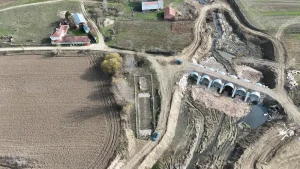
Crews completed structural assembly in only six days. Installation of the structure at the site took just one day.
That accelerated schedule reduced disruption to both the river environment and surrounding infrastructure compared with the conventional reinforced concrete construction described in the project submission.
Field assembly is one advantage of corrugated steel structural plate. Individual plates can be transported to the site and assembled into large structures that would be impractical to ship as completed units.
Other NCSPA projects demonstrate the same construction advantage under very different conditions. The Hardin Valley Middle School Entrance used buried steel bridge structures to meet both budget and schedule requirements.
Meanwhile, the North Carolina State Veterans Home Culvert demonstrated how flexible buried bridge design can also influence foundation requirements and overall project economics.
Building More Capacity Into the Crossing
The Kastamonu project addressed a problem facing infrastructure owners around the world: an existing crossing that no longer matched the hydraulic conditions around it.
Rather than simply replacing the original bridge in kind, the project created a larger hydraulic opening designed around current river conditions.
The six-cell corrugated steel bridge combines hydraulic capacity, structural flexibility and accelerated construction in one system. Once complete, it will provide a durable crossing while helping reduce flood risk in the surrounding area.
Projects such as Kastamonu also show why large hydraulic crossings increasingly require engineers to consider structure and waterway performance together.
For another example, Oregon’s Highway 47 Messing Creek project used structural steel plate to restore a flood-damaged crossing while increasing hydraulic capacity and supporting environmental connectivity.