Project Summary
A steep highway slope in Kamiah, Idaho, required a creative approach to replacing an aging 36-inch corrugated steel downdrain. Lane Enterprises developed a partially open steel system that improves maintenance access while maintaining secure connections along the grade.
A Different Kind of Highway Drainage Challenge
Highway drainage rarely gets the easy terrain. Along State Highway 64 near Kamiah, Idaho, the Idaho Transportation Department needed to replace an aging 36-inch full-round corrugated steel pipe downdrain. The existing system carried stormwater down an extremely steep roadside slope.
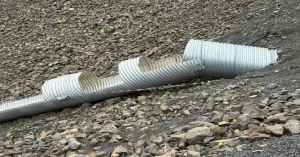
ITD wanted the replacement to provide easier inspection and maintenance access. An open half-round corrugated steel pipe system offered that advantage. However, opening the pipe created another challenge.
The project team needed a way to keep individual sections securely connected and anchored. Gravity and high-velocity runoff could cause an inadequately secured system to shift or separate. For a steep-slope drainage application, that simply was not an option.
Rebuilding SH-64 After Major Flood Damage
The downdrain work formed part of a much larger effort to repair State Highway 64. A major storm event in April 2024 caused multiple washouts and structural damage between Nez Perce and Kamiah. The highway closed on April 14 while the Idaho Transportation Department evaluated and repaired the damage.
ITD reported that emergency construction included retaining walls, road base reconstruction, paving, and repairs at approximately 12 slide locations. The agency accelerated design efforts to move construction forward and restore the highway. Against that backdrop, reliable drainage was an important part of restoring the corridor.
The project also demonstrates why transportation drainage systems must adapt to the terrain around them. Standard solutions do not always fit unusual field conditions.
Creating a Hybrid Full-Round and Half-Round Solution
Lane Enterprises, LLC developed a specialized configuration for the replacement system. Knife River Corporation served as contractor for the project. Instead of cutting each pipe section into a half-round shape from end to end, the team retained full-round sections at the connections. Each 20-foot section began as 36-inch, 14-gauge round corrugated steel pipe. The center portion was opened to create the accessible drainage channel, while full-round sections remained at the ends.
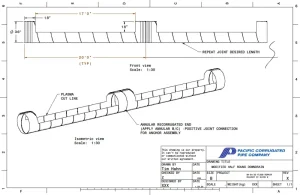
The submitted project drawing shows the same basic concept. Full-round corrugated ends provide connection points while the center becomes the open channel. That detail accomplished two objectives.
First, the open section gave ITD easier access for inspection and debris removal. Second, retaining full-round steel at the connection locations added strength compared with a completely open half-round system.
It is a relatively simple modification, but it demonstrates the fabrication flexibility available with corrugated steel products.
Keeping the Downdrain Together on a Steep Grade
Creating an open channel was only half the solution. The sections still had to stay together.
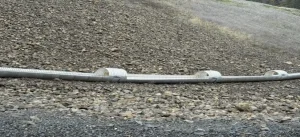
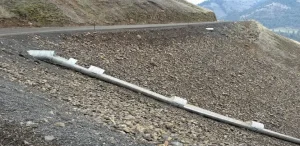
The steep slope made connection performance especially important. The project team developed an anchoring approach that secured the sections together and stabilized the system against movement. The full-round ends allowed the fabricated sections to use positive connections at the anchor locations. That matters on steep grades. NCSPA guidance notes that positive corrugated steel pipe joint connections provide tensile, shear, and moment strength and are well suited for steep-slope installations. Crews also had to carefully align and secure the sections along the grade. The finished system creates a continuous drainage path down the exposed rocky slope.
The result shows how special applications for corrugated steel pipe can address erosion and water conveyance challenges where conventional installations may not fit.
Better Access Without Sacrificing Stability
For ITD, the new configuration provides an important operational advantage.
Crews can access much of the open channel directly instead of working through a completely enclosed 36-inch pipe. That makes inspection and cleanup easier along the steep drainage route. At the same time, the system retains reinforced connection areas where they matter most.
The completed downdrain now provides reliable stormwater conveyance while addressing the maintenance challenges associated with the previous full-round system. More broadly, the SH-64 project demonstrates one of the practical advantages highlighted throughout NCSPA’s Why Steel resources: corrugated steel can be fabricated and adapted for site-specific infrastructure challenges.
Sometimes resilience comes from a massive structure. Other times, it comes from taking a familiar 36-inch pipe and cutting it in exactly the right places.
Related Project Stories
This project joins several NCSPA archive examples where unusual terrain or project conditions required customized steel drainage solutions.
The Caltrans Trinity Culvert Drainage Repairs used customized corrugated steel drainage components across 18 locations along Highway 299 in California. The project also demonstrates how DOT drainage systems can adapt to demanding mountainous environments.
Another California transportation project, the Highway 50 Camino Safety Project, required more than 5,100 feet of specialized slotted drain pipe as part of a larger highway improvement effort.
For another example of steel adapted to challenging site conditions, the Smith Ford Crossing featured a half-round CSP structure designed for small stream crossings. It appears within NCSPA’s older Project Spotlight archive and offers another example of designers moving beyond conventional round-pipe configurations.